

Wagenhausen provost church

The provost church in Wagenhausen is a former monastery on the banks of the Rhine, which was donated to the Benedictine monastery of All Saints in Schaffhausen by the nobleman Tuoto von Wagenhausen in 1083.
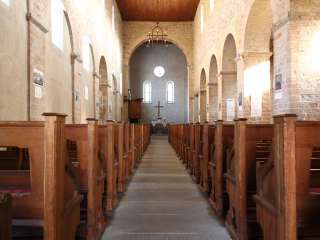
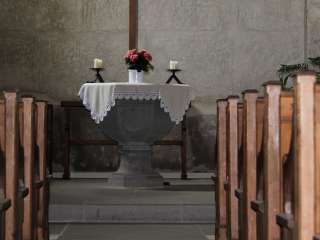
The church is a three-nave Romanesque basilica in the Lombard style. The northern aisle fell into disrepair due to the influence of the nearby Rhine and was demolished around 1600. The 13th century paintings on the triumphal arch have been preserved. The frescoes of St. Agatha (north wall), St. Sebastian (choir) and St. Anthony and Benedict (side apse) were created after 1500, the baptismal font in 1512. The pulpit dates from the 17th century.
In the cloister there are tombstones of provosts from the 18th and 19th centuries, as well as a plague coffin with a hinged base: In 1611, half the population of Thurgau was carried off by the plague; 71 people in Wagenhausen.
Three bells hang in the bell tower: a Marian bell from 1291, a large bell from 1514 and a small bell from 1953.
The exterior of the church was restored in 1937 and the interior in 1950/51. In 1970/71, three apartments were set up in the east and south wings, and the historic Provost's Hall (parish hall) is also housed in the east wing.


Address
Propstei 10
8259
Wagenhausen